
Design consulting is the professional planning and advisory process that turns your idea into a build-ready plan. From Galveston, Texas, Tip Top Builders uses design consulting to align permits, engineering, and constructibility for gas stations, commercial spaces, and homes—so you can break ground faster with fewer surprises and a clearer path to opening.
By Aftab Ali, Manager — Tip Top Builders • Visit our services overview
Last updated: 2026-06-02
At a glance
Design consulting reduces risk by validating sites, codes, utilities, and constructibility before you build. It clarifies scope, compresses schedules, and cuts rework. In Texas, a regulation-savvy partner coordinates agencies and inspections so fuel, retail, and residential projects move predictably from land to opening.
Use this guide to understand how design consulting works in the field—and how Tip Top Builders supports Texas developers, owners, and homeowners from pre-design through construction.
- What design consulting is and where it fits in construction
- Texas-specific permitting, environmental, and safety checkpoints
- Our gated workflow from discovery to permit-ready documents
- Engagement models: advisory, design-assist, and turnkey design-build
- Owner best practices, tools, templates, and decision cadences
- Mini case studies from fuel retail, retail shells, and coastal homes
Table of contents
- What is design consulting?
- Why it matters in Texas
- How design consulting works (our workflow)
- Types and engagement models
- Best practices for owners
- Tools and resources
- Case studies and examples
- FAQ
- Conclusion and next steps
What is design consulting?
Design consulting is expert guidance that translates a developer’s goals into compliant, constructible drawings and specifications. Consultants coordinate codes, utilities, and disciplines—architectural, civil, structural, and MEP—so bidders price apples-to-apples and field teams build without rework.
In practice, design consulting closes the gap between vision and buildability. We shape the site layout, access and circulation, drainage, and utility tie-ins. Then we align architectural intent with structural and MEP realities while tracking permit requirements and inspection sequences.
What it includes
- Codes and compliance: confirm zoning allowances, setbacks, height limits, and life-safety requirements; align ADA routes and egress strategy.
- Utilities and sitework: verify power, water, sewer, and telecom capacities; plan points of connection and trench sequencing.
- Disciplines coordination: civil, architectural, structural, mechanical, electrical, and plumbing aligned around one documented intent.
- Permit pathway: complete checklists, sealed calcs, and agency forms; pre-application meetings to reduce resubmittals.
- Constructibility reviews: page-turn checks at 30/60/90% to resolve clashes and value-engineer without scope drift.
What it is not
- Not a replacement for licensed design professionals; it coordinates and de-risks their work.
- Not an afterthought; impact is highest when engaged before site control or during due diligence.
- Not generic consulting; it’s focused on Texas authorities, utilities, and inspection realities.
Where it fits in the lifecycle
- Pre-acquisition: screen sites for access, utilities, drainage, and zoning risks to inform offers.
- Pre-design: define program, performance targets, and decision cadence with owners and A/E teams.
- Design development: align disciplines, run VE passes, and lock long-lead items.
- Permit and precon: assemble submittals, track comments, and prepare inspection matrices for handoff.
Deliverables typically include a coordinated drawing set, outline specifications, a living risk register, and a submittal/inspection roadmap that construction management can execute without guesswork. For a deeper primer on upstream steps, see our planning and design guide.
Why design consulting matters in Texas
Texas jurisdictions and utility providers vary widely. Design consulting front-loads code research, agency coordination, and constructibility reviews so owners avoid resubmittals, RFIs, and schedule slippage. Answer hard questions early—access, drainage, utilities, fuel systems—and mobilization becomes a controlled handoff.
We’ve found that projects adopting a structured preconstruction path see fewer early RFIs and smoother inspection closes across corridors like Galveston–Beaumont and Austin–College Station. The benefit compounds: fewer design surprises mean steadier procurement and cleaner mobilization.
Regulatory complexity
- Different checklists: submittal requirements change by city and county; a universal package causes comment cycles.
- Fire/life-safety coordination: fuel canopy clearances, dispenser setbacks, and fire apparatus paths must be documented early.
- Environmental diligence: screenings, drainage pathways, and stormwater controls should be planned with local reviewers in mind.
Utility coordination
- Capacity confirmation: planned loads and points of connection verified before design freeze prevents trench conflicts later.
- Sequence mapping: trenching, backfill, and inspections sequenced with roadway access to keep crews flowing.
- Third-party timing: utility provider lead times integrated into procurement and inspection calendars.
Inspections and testing
- Inspection matrices list undergrounds, rough-ins, pours, and finals so nothing stalls for missing paperwork.
- Pressure tests, compaction verifications, and as-builts are prepped as part of the design intent, not as an afterthought.
- Photometrics and signage packages are tuned to local expectations to simplify approvals.
See how these moves connect to execution in our planning and development overview, where we map submittals and agency touchpoints to decision gates.
How design consulting works (our workflow)
Our workflow moves from discovery to permit-ready documents with gated reviews. Each phase ends with a decision, an updated risk register, and a refined schedule. The handoff to construction management includes bid scopes, submittal and inspection logs, and long‑lead alignment.
We use a “gated” approach that balances speed and diligence. The goal is fewer unknowns in the field and a cleaner, faster path to opening.
Step-by-step workflow
- Discovery and due diligence: clarify program, constraints, and success metrics. Review zoning allowances and adjacent influences; scan recorded easements and setbacks.
- Site selection support: assess access, traffic patterns, visibility, utilities proximity, topography, and potential environmental flags.
- Concept design: lay out circulation, parking, canopy/store relationships, grading intent, and preliminary utility routing; schedule pre-application conversations.
- Design development: coordinate civil/architectural/structural/MEP; issue outline specs; run constructibility and value-engineering passes; update long‑lead list.
- Permit set and submittal: assemble sealed drawings, calculations, and forms; submit; track comments and resubmittals; align inspection plan.
- Preconstruction handoff: package bid scopes, submittal log, inspection matrix, and procurement sequencing for construction management.
| Phase | Key Deliverables | Owner Decisions |
|---|---|---|
| Due diligence | Zoning memo, utility markouts, high‑level risk register | Go/no‑go, program priorities |
| Concept design | Site concept, massing, preliminary drainage paths | Preferred layout, access strategy |
| Design development | Coordinated A/E set, outline specs, VE options | Material systems, VE selections |
| Permit set | Sealed drawings, calcs, application forms | Final scope approvals |
| Preconstruction | Bid packages, submittal log, inspection matrix | Contracting approach, start window |
To see how this connects to execution, review our construction management services page—where we convert design intent into daily coordination, safety, and quality control in the field.
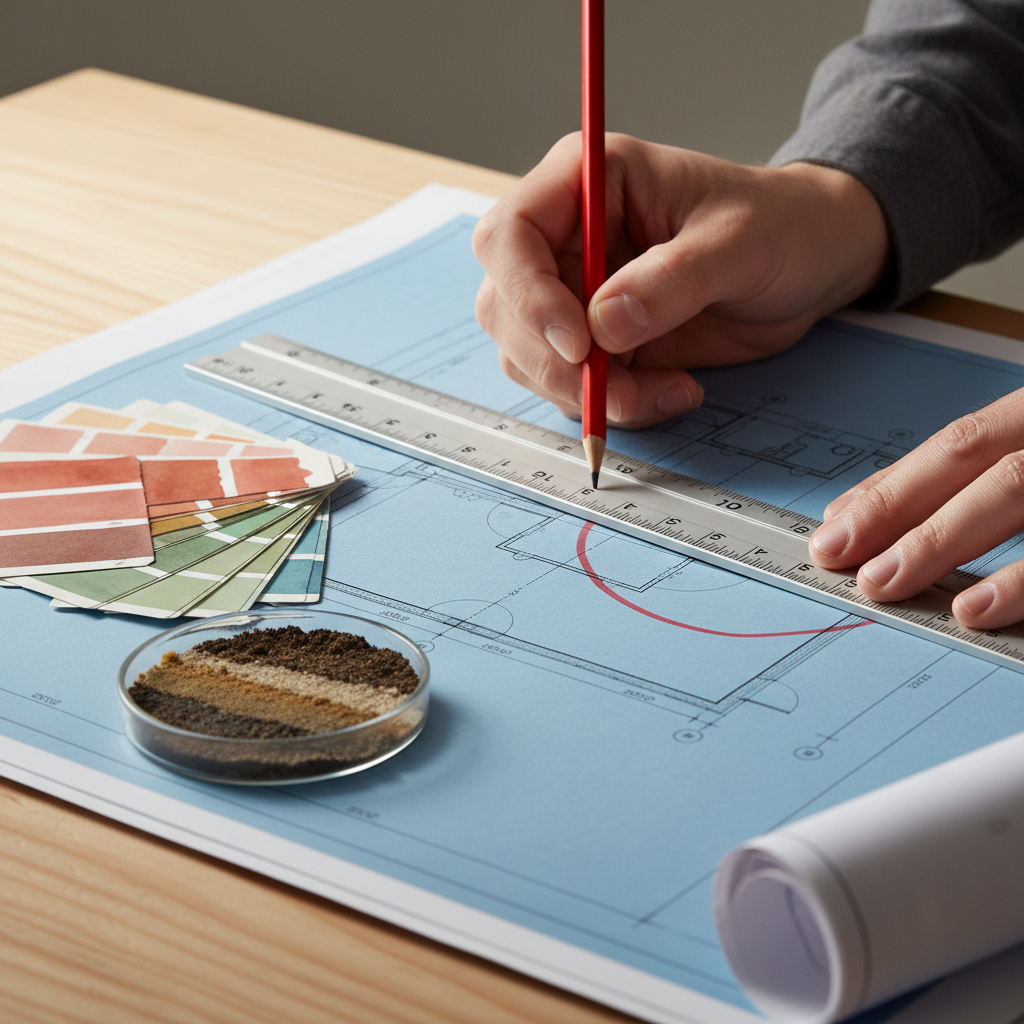
Decision gates explained
- 30% review: confirm site layout, access, and drainage approach; capture early agency feedback.
- 60% review: coordinate disciplines and utilities; freeze program and core systems.
- 90% review: finalize details and specs; lock inspection matrix and long-lead list.
Documentation you’ll receive
- Scope matrix; submittal log; risk register; utility tracker; inspection matrix.
- Decision log summarizing owner choices and rationale at each gate.
- Permit-ready drawing set and sealed calculations, when applicable.
Local considerations for Galveston
- Account for coastal wind loads and corrosion resistance; specify fasteners and coatings suitable for salt‑air exposure.
- Plan schedules around seasonal storms and peak travel weeks to protect mobilization and inspections.
- Design drainage and elevations with local rainfall patterns in mind to reduce ponding and preserve paving.
Types and engagement models
Pick the model that fits your risk, speed, and in‑house capacity. Advisory targets reviews and risk; design‑assist embeds us with your A/E; turnkey design‑build unifies design, permitting, and construction under one accountable partner.
We support several practical approaches that meet owners where they are:
- Advisory: focused code reviews, constructibility audits, schedule risk mapping, and VE checkpoints. Ideal when you already have an architect and need a buildability lens.
- Design‑assist: collaborative coordination with your architect/engineers to align site, civil, structural, MEP, and fuel systems. Useful for complex sites with multiple utilities or circulation constraints.
- Turnkey design‑build: a single‑point team that owns design through construction management—streamlining handoffs and accelerating approvals.
Which model should you choose?
| Model | Speed | Accountability | Flexibility | When it fits |
|---|---|---|---|---|
| Advisory | Moderate | Shared | High | Have A/E team; want risk checks and constructibility |
| Design‑assist | Fast | Shared | Moderate | Complex utilities/circulation; need tight coordination |
| Design‑build | Fastest | Single‑point | Moderate | Ground‑up fuel/retail; prefer one accountable partner |
Soft CTA: Want a quick, risk-focused pre-design review? Call 409-225-1137 to schedule a 20‑minute discovery conversation with our Galveston team.
Explore how these models play out on fuel and retail projects in our gas station construction guide and our architecture and design overview.
Best practices for owners and developers
Strong projects start with clarity. Define scope, decision cadence, and documentation early. Lock critical codes, coordinate utilities and access, maintain a living risk register, and hold disciplined design reviews so the team stays aligned with performance, budget, and schedule.
Owner checklist
- Define the program: fuel positions, canopy/store size, back‑of‑house needs, and parking targets.
- Gather inputs: boundary/topo surveys, geotechnical report, title/easements, utility availability letters.
- Set governance: who decides, when, and with which data; publish a decision log.
- Map inspections: undergrounds, rough‑ins, pressure tests, concrete pours, finals.
- Track long‑leads: electrical gear, canopy steel, specialty equipment, and review windows.
Coordination tips
- Hold page‑turn reviews at 30/60/90% design to catch clashes and document decisions.
- Model traffic/circulation to separate passenger cars, trucks, and fuel deliveries.
- Align photometrics, signage, and elevations with local expectations to reduce revisions.
- Document context‑specific wind, drainage, and corrosion strategies—especially near the coast.
Common pitfalls to avoid
- Late utility coordination: discovering a load shortfall after design freeze forces redesign and schedule resets.
- Untracked decisions: verbal choices without a log create churn later and inconsistent bids.
- Skipping pre-application: missing an early check-in often means a full review cycle is lost.
- One-size-fits-all details: using generic sections or photometrics that don’t match local preferences triggers comments.
For an orientation to common project methods, see this overview of project methodologies. While it’s not Texas‑specific, the frameworks help owners understand how roles and risks shift between models.
Tools and resources
Lightweight templates keep teams synchronized. Use a scope matrix, submittal log, utility tracker, and risk register—paired with jurisdictional checklists. Simple tools, updated weekly, prevent missed items and protect your schedule.
- Scope matrix: define ownership for civil, structural, MEP, fuel, signage, landscaping, and inspections to eliminate gaps.
- Submittal log: plan reviews, agency forms, sealed calcs, shop drawings, and inspection requests with target dates.
- Risk register: list item, likelihood, impact, owner, mitigation, and trigger date; review in every gate.
- Utility tracker: application IDs, loads, meters/taps, points of connection, and trench sequencing.
- Inspection matrix: undergrounds (fuel/electrical/plumbing), rebar and slab, rough‑ins, finals.
Starter templates (copy/paste)
Scope Matrix (excerpt)
Discipline, Owner, Reviewer, Notes
Civil, Tip Top Builders, City Eng., Drainage paths confirmed
Structural, A/E Team, Plan Review, Wind load fasteners: coastal spec
MEP, A/E Team, Utility Provider, Load letter submitted
Fuel, Tip Top Builders, Fire Marshal, Dispenser setbacks verified
Risk Register (excerpt)
Item, Likelihood, Impact, Owner, Mitigation
Utility capacity unknown, Med, High, Owner, Request load confirmation early
Storm season overlap, Med, Med, GC, Build float into inspection plan
Canopy steel long-lead, High, Med, CM, Release early after 60% review
Need a primer on what happens before shovels hit the ground? This short pre‑construction consultation guide outlines early coordination tasks that pair well with a structured design process.
If you’re weighing partner capabilities, you can also benchmark against a general industry construction and engineering guide to form evaluation criteria for experience, safety, and communication.
To see our approach mapped to Texas conditions, explore our building construction guide, which connects preconstruction planning to site mobilization, safety, quality, and daily coordination.
Case studies and real‑world examples
When design decisions happen early, projects run smoother. These snapshots show how resolving access, drainage, and fuel‑system details before submittal avoided redesigns, scheduled inspections with confidence, and protected opening targets across Texas markets.
Fuel + C‑store on raw land
- Challenge: coordinate underground tanks, canopy steel, and traffic separation without compromising drainage or delivery paths.
- What we did: sequenced utility crossings, refined canopy column locations, optimized grading and curb radii, and verified tanker truck sweeps.
- Result: fewer RFIs during undergrounds and a clean path to slab pour and canopy erection.
Retail shell with future tenants
- Challenge: meet egress and accessibility while providing flexible utilities for unknown tenant mixes.
- What we did: standardized utility stubs, clarified demising wall requirements, and documented TI allowances in the base set.
- Result: tenant improvements started quickly without site rework or parking recalculations.
Custom residential in coastal Texas
- Challenge: align aesthetics with wind‑load and corrosion‑resistance needs near the coast.
- What we did: specified coastal hardware and protective finishes, elevated critical equipment, and tuned elevations for drainage.
- Result: reduced maintenance exposure and clean inspections at each stage.
Small‑site fuel infill
- Challenge: limited frontage and tight turning radii for delivery trucks.
- What we did: used turning templates to verify tanker paths, adjusted curb lines, and coordinated delivery windows.
- Result: safe circulation without encroaching on adjacent drives.
Convenience store renovation
- Challenge: modernize elevations, lighting, and interior flow while staying open.
- What we did: phased work with temporary partitions, sequenced inspections, and kept accessible routes intact.
- Result: refreshed look with minimal downtime and predictable inspections.

Mixed‑use parking and access
- Challenge: competing parking ratios and shared access with neighboring parcels.
- What we did: negotiated shared‑access agreements, balanced parking counts, and aligned photometrics to minimize spill.
- Result: approvals moved without major redesigns.
Rural site utilities
- Challenge: long utility runs and variable soil conditions.
- What we did: confirmed loads and points of connection early, sequenced trenching, and verified compaction requirements.
- Result: trenching and backfill proceeded without rework or unplanned holds.
Stormwater compliance on retail pad
- Challenge: site drainage conflicting with desired parking layout.
- What we did: tuned grading, adjusted inlets, and coordinated curb profiles to maintain accessible routes and capture flows.
- Result: smooth inspections and no ponding during initial rains.
Shell expansion phasing
- Challenge: adding a new bay and storefront while tenants remained operational.
- What we did: staged structural work, preserved egress, and synchronized inspections with tenant schedules.
- Result: expansion completed with minimal disruption and a clean C of O path.
Campus‑adjacent retail pad (College Station)
- Challenge: heavy pedestrian flows and tight delivery windows near a campus corridor.
- What we did: separated service access from customer routes, tuned lighting to minimize glare, and coordinated inspector availability around peak periods.
- Result: approvals cleared on schedule with safe circulation during opening week.
See how these planning moves connect to delivery in our high‑level building design and construction guide, which links design intent to daily field coordination.
Frequently asked questions
Here are crisp answers to the most common questions Texas owners ask. Each reflects how design consulting integrates with permitting and construction management for predictable delivery.
How early should we bring in design consulting?
Bring a consultant in before site control if you can. Early input on access, utilities, drainage, and zoning makes offers smarter and reduces surprises. If the site is already secured, start during due diligence to protect momentum.
What’s the difference between advisory, design‑assist, and design‑build?
Advisory focuses on reviews and risk mapping; design‑assist collaborates with your A/E to coordinate systems; design‑build unifies design, permitting, and construction under one accountable partner. Choose based on scope, speed, and in‑house capacity.
Do you coordinate permits and inspections in Texas?
Yes. We assemble permit sets, submit to the authority having jurisdiction, track review comments, and map inspection sequences. Our team schedules critical inspections so construction can progress without stalls.
Where does design consulting hand off to construction management?
After permit approvals, we finalize bid scopes, align procurement for long‑lead items, and deliver submittal and inspection logs. Construction management then leads mobilization, safety, quality, and daily coordination using the documented design intent.
Conclusion and next steps
Design consulting is the fastest way to de‑risk Texas builds. When codes, utilities, and constructibility are aligned up front, projects move faster with fewer RFIs and smoother inspections. If predictability matters, start preconstruction with a partner accountable from land to opening.
- Action steps: assemble surveys and geotech reports, define your program, and schedule a discovery call so we can begin due diligence.
- Explore our architecture and design services to see how we turn concepts into build‑ready plans.
Key takeaways
- Front‑load decisions and track them in a living log.
- Coordinate utilities and access before design freeze.
- Use 30/60/90% reviews to catch clashes early.
- Pair a risk register with an inspection matrix to protect milestones.
- Choose the engagement model that matches your risk and speed.