
Gas station canopy construction is the engineered design and build of roofed structures over fuel islands to protect customers, equipment, and operations. It involves structural steel, lighting, drainage, and code compliance. For Galveston operators, the right canopy reduces risk, improves throughput, and strengthens brand visibility—especially in coastal wind and rain.
By Aftab Ali — Manager, Tip Top Builders
Last updated: 2026-06-21
Start here: your canopy game plan for Texas
Define function, codes, and schedule first. A winning canopy plan aligns branding, 130–150 mph wind design, 14–16 ft clear height, and safe lighting. Then map permits, utilities, and fabrication lead times so the steel arrives when foundations cure and electrical rough-in is ready.
Tip Top Builders delivers land-to-opening support for fuel retail across Texas. We handle planning and design, site preparation and excavation, construction management, and turnkey build. This guide shows how to make your canopy durable, code-compliant, and easy to maintain.
Quick Summary
- Set clear performance targets: wind, drainage, lighting, and traffic flow.
- Sequence permits, utilities, footings, steel, and fascia to cut delays.
- Use LED lighting (20–30 footcandles at grade) for safety and efficiency.
- Design 1–2% canopy slope with hidden gutters and protected downspouts.
- Coordinate fuel, power, and data runs before slab and island concrete pours.
Table of contents
- What is a gas station canopy?
- Why canopy design matters
- How canopy construction works
- Types, framing, and methods
- Best practices for Texas
- Tools, materials, and resources
- Texas case studies and examples
- Frequently Asked Questions
- Key takeaways and next steps
What is a gas station canopy?
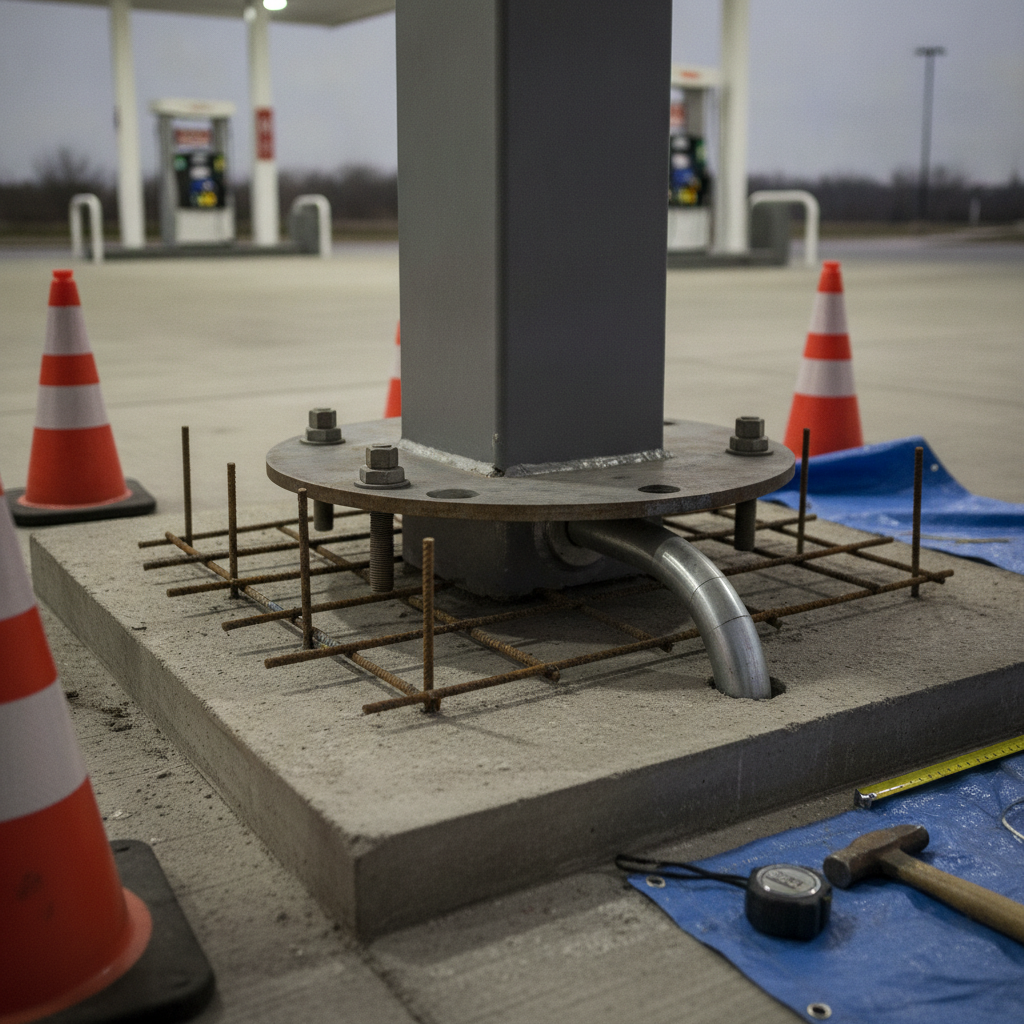
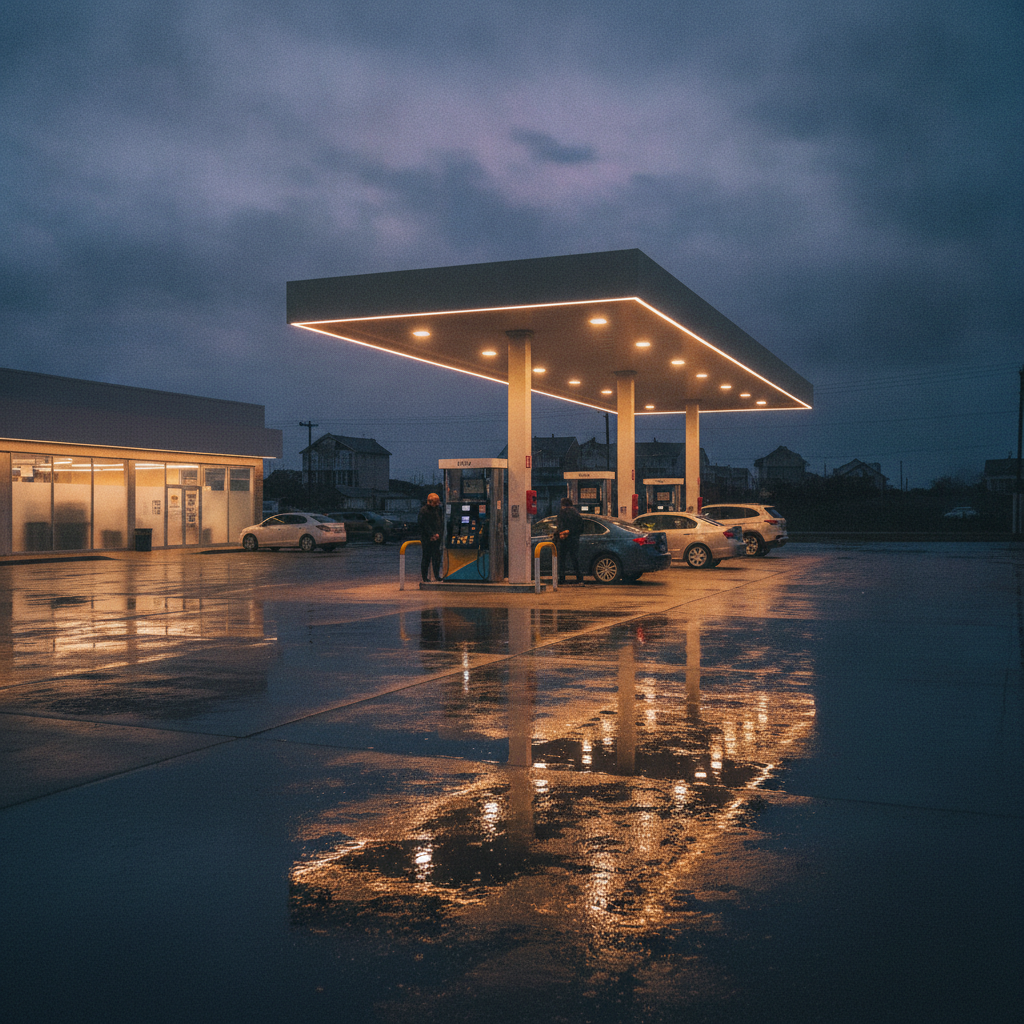
A gas station canopy is a steel-framed, roofed structure installed over fuel dispensers to shield customers and equipment from weather while supporting lighting, signage, and drainage. Its design integrates structural loads, wind uplift, electrical systems, and stormwater management to keep the forecourt safe and efficient.
At its core, a canopy is an engineered system that blends architecture, structural steel, and MEP integration. Typical systems feature 20–30 ft column spacing, 14–16 ft clear height for vehicle access, 1–2% roof slope, and integrated LED lighting. The assembly includes columns, beams, purlins, decking, fascia, soffit, gutters, and downspouts.
- Primary functions
- Protect people and equipment from rain, sun, and wind.
- Provide consistent lighting levels (target 20–30 footcandles at grade).
- Reinforce branding via fascia color and sign integration.
- Core components
- Steel columns and beams with bolted connections.
- Decking panels, fascia, soffit, and integrated gutters.
- Conduits for power, controls, security, and signage.
In our experience across Texas, well-designed canopies reduce slip-and-fall incidents, speed fueling during storms, and lower maintenance. For a broader build context, see our gasoline station construction guide covering full-site coordination.
Why canopy design and construction matter
Great canopy design improves safety, throughput, and brand trust. It controls glare, sheds water away from fueling, withstands 130+ mph winds, and simplifies maintenance. Operators see faster service during rain, fewer liability risks, and better curb appeal—key advantages in competitive fuel retail.
Here’s the thing: forecourt experience drives repeat visits. Bright, uniform light makes payment, fueling, and wayfinding faster. A clean fascia and soffit cue quality. Robust drainage prevents ponding around dispensers. In storm-prone Gulf markets, wind and corrosion resistance extend lifespan and reduce callouts.
- Safety and liability
- Uniform lighting reduces trip hazards; aim for 20–30 footcandles.
- Dry fueling positions lower slip risk; 1–2% roof slope helps.
- Clear sightlines aid video coverage and staff supervision.
- Operational performance
- Consistent illumination speeds card taps and hose swaps.
- Tall clearances (14–16 ft) accommodate SUVs and delivery vans.
- Accessible downspouts simplify seasonal cleanouts.
- Brand and compliance
- Fascia color and edge lighting reinforce identity.
- Wind design in Gulf counties commonly targets 130–150 mph.
- Drainage integrates with site stormwater plans and BMPs.
Many Texas owners pair canopy upgrades with interior C-store refreshes to lift basket size. If you’re planning both, our convenience store building guide outlines sequencing to minimize downtime.
How gas station canopy construction works (from permit to punchlist)
The canopy build sequence runs from zoning and utility coordination to foundations, steel erection, electrical trim, and final inspections. Success hinges on timing: pour footings as anchor bolt templates arrive, schedule crane day after concrete strength, and trim LEDs once fascia is sealed.
Our construction management team uses a structured workflow so the canopy package dovetails with sitework, tanks, and C-store build-out. Most canopy-only scopes run 12–16 weeks once permits clear, depending on steel lead times and weather windows. Here’s the typical sequence we manage across Texas:
- Planning and permits — Confirm zoning, fire marshal input, and utility conflicts. Coordinate photometrics showing 20–30 footcandles at the apron. See our Texas building permits overview for submittal tips.
- Subsurface and layout — Verify tank setbacks, dispenser spacing, and column grid (often 20–30 ft). Survey control points and lay out footings and conduit runs.
- Foundations — Excavate and pour footings with templates for 3/4–1-1/4 in anchor bolts. Typical embed depths are engineered; many sites need 4–6 ft depending on soils and wind.
- Steel fabrication — Order columns, beams, purlins, and decking. Galvanize or coat for coastal exposure; specify 11–12 gauge fascia panels for dent resistance.
- Erection and bolting — Set columns with a crane, plumb, torque connections, and install bracing. Deck panels follow, then fascia/soffit.
- Electrical and lighting — Pull feeders and low-voltage, set drivers, and aim LED fixtures. Commission controls to maintain 20–30 fc at grade.
- Drainage integration — Tie downspouts into storm lines, away from fueling positions. Protect with bollards where vehicles turn.
- Branding and signage — Install channel letters, edge lighting, and color bands per brand book.
- QA/QC and inspections — Torque checks, insulation resistance tests, and water tests at gutters. Close punchlist and deliver O&M manuals.
| Phase | Main deliverables | Typical duration |
|---|---|---|
| Permitting | Stamped drawings, photometrics, drainage tie-in | 3–6 weeks |
| Foundations | Excavation, forms, rebar, anchor bolts | 1–2 weeks |
| Steel & fascia | Fabrication, erection, decking, cladding | 4–8 weeks |
| MEP & branding | Lighting, controls, signage install | 1–2 weeks |
| Closeout | Testing, inspections, O&M handover | 1 week |
To keep your timeline predictable, we integrate canopy milestones into the master build. Explore our commercial construction in Texas guide for risk controls that keep schedules tight.
Types of canopy structures and construction methods
Most fuel canopies use steel moment frames with purlins and metal decking, wrapped in fascia and soffit. Variations include single- vs. double-row islands, cantilevered edges, and integrated brand elements. Coastal sites favor galvanized or coated steel and robust connections for high winds.
Choosing the right framing system depends on site geometry, dispenser count, and exposure. We size columns and beams for wind uplift and consider expansion for future EV chargers. Here are common approaches we build across Texas:
- Moment-frame steel
- Two or more rows of columns with rigid beam connections.
- Efficient for 2–8 fueling positions; scalable to larger forecourts.
- Decking spans with purlins for stiffness and roof slope.
- Truss-supported spans
- Open-web or box trusses for wider bays or reduced columns.
- Useful where tanker paths or ADA routes constrain column locations.
- Cantilever and overhangs
- Extended eaves improve rain protection over dispensers.
- Requires careful connection design for uplift and deflection.
- Materials and cladding
- Galvanized steel in coastal zones prolongs life.
- 11–12 gauge fascia panels resist impacts; sealed seams fight corrosion.
- Composite soffit panels reduce oil staining and ease cleaning.
If you want to dive deeper into framing approaches, this structural steel framing guide provides a useful overview of system types and performance tradeoffs.
Best practices for Texas canopy projects
Design for Gulf weather, coordinate utilities early, and protect maintenance access. Specify corrosion-resistant steel, accessible gutters, and bollard-guarded downspouts. Plan lighting controls, signage raceways, and future EV conduits before concrete, then verify torque values and water tests during closeout.
Texas sites span coastal humidity, inland heat, and flash rain. We tailor details so your canopy holds up and stays easy to service. The checklist below blends structural, electrical, and site coordination best practices we apply in Galveston and across the state.
Structural and drainage
- Engineer for local design wind speeds; Gulf counties often exceed 130 mph.
- Detail 1–2% roof slope with internal gutters and debris strainers.
- Route downspouts away from fueling islands; add bollards at turn zones.
- Use hot-dip galvanizing or high-build coatings in coastal air.
Electrical and lighting
- Target 20–30 footcandles at grade; add dimming for late-night hours.
- Locate drivers and junctions in protected, accessible soffit zones.
- Pre-run spare conduits for signage, cameras, and EV upgrades.
- Commission lighting scenes to cut glare at the C-store entry.
Construction management
- Template anchor bolts before the pour; document torque values at set.
- Sequence crane day after cylinders confirm break strength.
- Bundle inspections: structural, electrical, and storm tie-ins in one visit.
- Verify clear heights (14–16 ft) at final fascia alignment.
Local considerations for Galveston
- Plan coatings and sealants for salty coastal air and high humidity; schedule touch-ups after major storms.
- Build wind windows into the schedule during peak storm seasons; secure decking and fascia staging accordingly.
- Coordinate drainage tie-ins to manage heavy rain bursts common to the Gulf; keep downspouts protected from turning traffic.
When permitting and zoning questions come up, our planning and zoning guide can help you prepare clean submittals and avoid resubmittals.
Tools, materials, and resources
Use survey control, anchor bolt templates, torque wrenches, and laser levels to speed install. Favor galvanized steel, LED fixtures with sealed optics, composite soffit panels, and high-build coatings in coastal air. Keep O&M manuals and torque logs handy for inspections and warranty.
A reliable kit and spec package makes canopy work predictable. We standardize tools and materials so crews move fast and inspectors get clear documentation. Below is a practical inventory and why it matters.
Field tools and checks
- Laser levels and total station for column plumb and elevation.
- Torque wrenches and calibrated sockets for bolted joints.
- Insulation resistance tester for lighting circuits.
- Water test gear for gutter/downspout verification.
Materials that last
- Galvanized columns, beams, and hardware for corrosion resistance.
- 11–12 gauge fascia with sealed corner joints.
- LED canopy luminaires with sealed, easy-clean lenses.
- Composite soffit panels to reduce staining and simplify washing.
Helpful references
- Photometric layouts targeting 20–30 fc at grade with uniformity.
- Torque logs for structural inspections.
- O&M manuals for lighting and coatings.
For a general safety refresher, this field-oriented article on improving construction site safety offers practical reminders for crews.
Case studies and examples from Texas
Smart sequencing and coastal-ready specs pay off. In recent Texas projects, we aligned permits, foundations, and steel delivery to finish canopy work in roughly 12–16 weeks, maintained 20–30 fc lighting, and protected drainage during heavy rain—without disrupting fuel operations.
We work statewide from our Galveston base, supporting new builds and redevelopments. These anonymized vignettes show how planning and details turn into results.
Gulf Coast rebuild, coastal Texas
- Challenge: Salt-laden air, frequent squalls, tight drive aisles.
- Approach: Galvanized steel, bollard-guarded downspouts, 1–2% slope to hidden gutters.
- Result: Smooth operations during rain events, clean fascia after storm season.
College Station forecourt refresh
- Challenge: Dim lighting and aging fascia hurt night traffic.
- Approach: LED luminaires targeted at 25–30 fc, new composite soffit.
- Result: Brighter apron, quicker throughput, fewer customer complaints.
Austin expansion with future EV
- Challenge: Prepare for added dispensers and eventual chargers.
- Approach: Moment-frame canopy sized for expansion; spare conduits for signage, cameras, EV.
- Result: Simple future tie-ins with no canopy teardown.
If you’re coordinating a full site build, our complete construction services overview explains how we roll canopy scopes into a turnkey program.
Frequently Asked Questions
Owners ask about permits, timelines, materials, and maintenance. In Texas, expect coordinated reviews, 12–16 week build windows after approvals, galvanized steel in coastal areas, and annual cleaning plus periodic torque checks. Preplanning utilities and drainage prevents the most common delays.
What permits are needed for a canopy in Texas?
You’ll submit architectural, structural, electrical, and drainage details to local authorities. Reviews often involve building officials and the fire department. We prepare photometrics, wind design notes, and storm tie-ins so the canopy package aligns with the overall gas station approvals.
How long does gas station canopy construction take?
Once permits are cleared and steel is in fabrication, canopy scopes typically run 12–16 weeks, weather depending. The schedule covers foundations, steel erection, electrical trim, drainage ties, and punchlist. Integrating the canopy with sitework reduces idle time and crane remobilizations.
What lighting levels should we target under the canopy?
Aim for 20–30 footcandles at grade with uniform distribution to reduce glare and shadows. We use LED fixtures with sealed lenses, smart controls for late-night dimming, and photometric layouts to validate performance before procurement and installation.
How do you protect drainage around fueling positions?
We slope the canopy 1–2% to internal gutters, route downspouts away from dispensers, and guard discharge points with bollards in turn zones. During heavy rain, this approach keeps fueling areas drier and reduces slip risks while easing maintenance access.
Key takeaways and next steps
Lock in performance targets early, sequence foundations and steel to avoid downtime, and protect drainage and maintenance access. With solid specs and schedule control, Texas canopy projects finish faster and perform better through storms, heat, and heavy traffic.
- Confirm wind design, lighting (20–30 fc), slope (1–2%), and clear heights (14–16 ft).
- Order steel early; template anchor bolts before pours.
- Pre-run conduits for signage, cameras, and future EV.
- Water-test gutters and verify torque values at closeout.
Need a canopy built or upgraded? Let’s map your forecourt plan. Start with our environmental planning overview, then coordinate your permits using our Texas permits guide. We’ll align canopy milestones with sitework to keep fuel flowing.
Soft consultation invite
Planning a new gas station or forecourt refresh in Texas? Our team in Galveston manages planning and design, site preparation and excavation, and full construction management. Reach out to Tip Top Builders to schedule a quick feasibility review.
For a general electrical planning refresher before you pick fixtures, see this concise electrical construction primer.