
Urban design is the coordinated shaping of streets, blocks, public spaces, and infrastructure to create safe, efficient, and attractive places. It translates policy into buildable geometry. For developers in Galveston, Texas, Tip Top Builders applies urban design principles from planning through construction to deliver walkable, code-compliant, and high-performing sites.
By Aftab Ali — Manager, Tip Top Builders
Last updated: 2026-05-15
Overview and Table of Contents
Urban design aligns buildings, streets, utilities, and open spaces so people can move safely and businesses can thrive. This guide explains what urban design is, why it matters in Texas, and how to implement it—from due diligence and permitting to site layout, drainage, and delivery operations.
- What urban design is and how it differs from urban planning and architecture
- Why it improves safety, access, sustainability, and business performance
- How to go from policy to buildable drawings and inspections
- Practical methods, street types, and green infrastructure details
- Best practices we specify on Texas fuel retail, commercial, and residential sites
- Tools, resources, and step-by-step workflow you can apply this week
- What Is Urban Design?
- Why Urban Design Matters
- How Urban Design Works
- Types, Methods, and Approaches
- Best Practices
- Tools and Resources
- Case Studies and Examples
- Process & Delivery Models
- Frequently Asked Questions
- Key Takeaways
- Conclusion and Next Steps
What Is Urban Design?
Urban design is the discipline that shapes the public realm—streets, blocks, and open spaces—by coordinating land use, building form, mobility, and utilities. It bridges policy and construction, turning codes and master plans into site-scale layouts, cross-sections, and details that contractors can build.
At its core, urban design turns abstract policy into measurable standards. That includes block lengths (often 300–600 feet), lane widths (10–11 feet on urban streets), sidewalk zones (6–10 feet clear), corner radii (20–25 feet to slow turns), and curb-return geometry that matches delivery vehicle paths. These numbers guide how people walk, drive, and park each day.
How it differs from planning and architecture
- Urban planning: citywide land use, network planning, and policies for growth.
- Urban design: block structure, street sections, frontage types, and public-space standards.
- Architecture: individual buildings—elevations, facades, and systems within a parcel.
Tip Top Builders connects these layers in preconstruction so permits, drawings, and construction logistics line up without surprises. Our planning and design services tie zoning, urban design, and architecture together with constructability in mind.
Why Urban Design Matters (Safety, Access, Value)
Good urban design reduces conflicts, clarifies movement, and improves comfort. Right-sized lanes, short crossings, and integrated drainage make sites safer and simpler to navigate. Those improvements typically increase visits, extend dwell time, and protect long-term operations.
Safety and comfort you can measure
- Shorter crossings: Curb extensions can trim crossing distance by 20–40%, improving visibility and yielding.
- Predictable speeds: Urban lane widths of 10–11 feet help calm traffic while maintaining throughput.
- Lighting uniformity: Full-cutoff fixtures reduce glare and improve nighttime comfort at driveways.
Business performance and site logistics
- Active frontage: Doors every 25–40 feet and clear glazing increase casual browsing and capture.
- Wayfinding: Two-way drive aisles at 24–26 feet and marked pedestrian routes reduce conflicts.
- Drainage integration: Bioswales and permeable surfaces reduce ponding, preserving parking and ADA routes.
In our Texas work, small geometric moves—like reducing a curb return from 35 to 25 feet—lower turning speeds at entries and make walking safer without hurting access. That’s the kind of practical, high-leverage change urban design delivers.
For a quick primer on exterior hardscape considerations that support drainage and durability, see this context piece on things to consider before hardscaping.
How Urban Design Works (From Policy to Detail)
Urban design turns policy into buildable geometry. The workflow runs from due diligence and codes, to concept diagrams, to engineered site plans with grading, drainage, and details. When geometry is clear up front, permitting reviews shrink and construction rework drops.
Step-by-step workflow Tip Top Builders uses
- Due diligence: Verify zoning, setbacks, access spacing, floodplain, utilities, and environmental constraints.
- Concept layout: Test building placement, block structure, and access points; set parking ratios and service routes.
- Street and frontage standards: Fix lane widths, sidewalks, bike lanes, tree zones, and driveway geometry.
- Stormwater strategy: Size detention, outfalls, and green infrastructure early so layouts survive engineering.
- Permitting package: Align site plan, landscape, lighting, and traffic exhibits with submittal checklists.
- Build logistics: Phase grading, utilities, and paving to keep inspectors, trades, and deliveries coordinated.
On fuel retail projects, we add canopy clearances, tank setbacks, queue lengths (often 2–3 cars per pump), and dedicated fire-lane geometry. Our construction management team sequences inspections, from pre-pour checks to final striping, so the design intent survives each field decision.
Want a deeper dive on preconstruction? Our Texas planning and design guide outlines the due-diligence checklists we use before any line is drawn.
Types, Methods, and Approaches You’ll Use
Common approaches include context-based street design, form-based codes, and site-scale Complete Streets. For private developments, the most practical tools are cross-sections, frontage types, access management, and green infrastructure built into parking and edges.
Street and intersection types (with target dimensions)
- Main streets: 10–11 ft lanes, 8–10 ft parking, 6–10 ft sidewalks, curb extensions at crossings.
- Commercial arterials: Access spacing of 300–600 ft; medians to manage turns; right-turn pockets where warranted.
- Neighborhood streets: 9–10 ft lanes, 5–8 ft sidewalks, street trees planted 25–40 ft on center.
- Intersections: Tight curb radii (20–25 ft) to slow turns; daylighting at corners for visibility.
Frontage and block structure
- Active frontage with frequent doors and windows improves safety perception and retail capture.
- Service alleys move loading and dumpsters off primary frontages to reduce conflicts.
- Block length in the 300–500 ft range boosts route choice and disperses traffic.
Green infrastructure that works on job sites
- Bioswales in parking rows with 2–5% longitudinal slope and check dams to slow runoff.
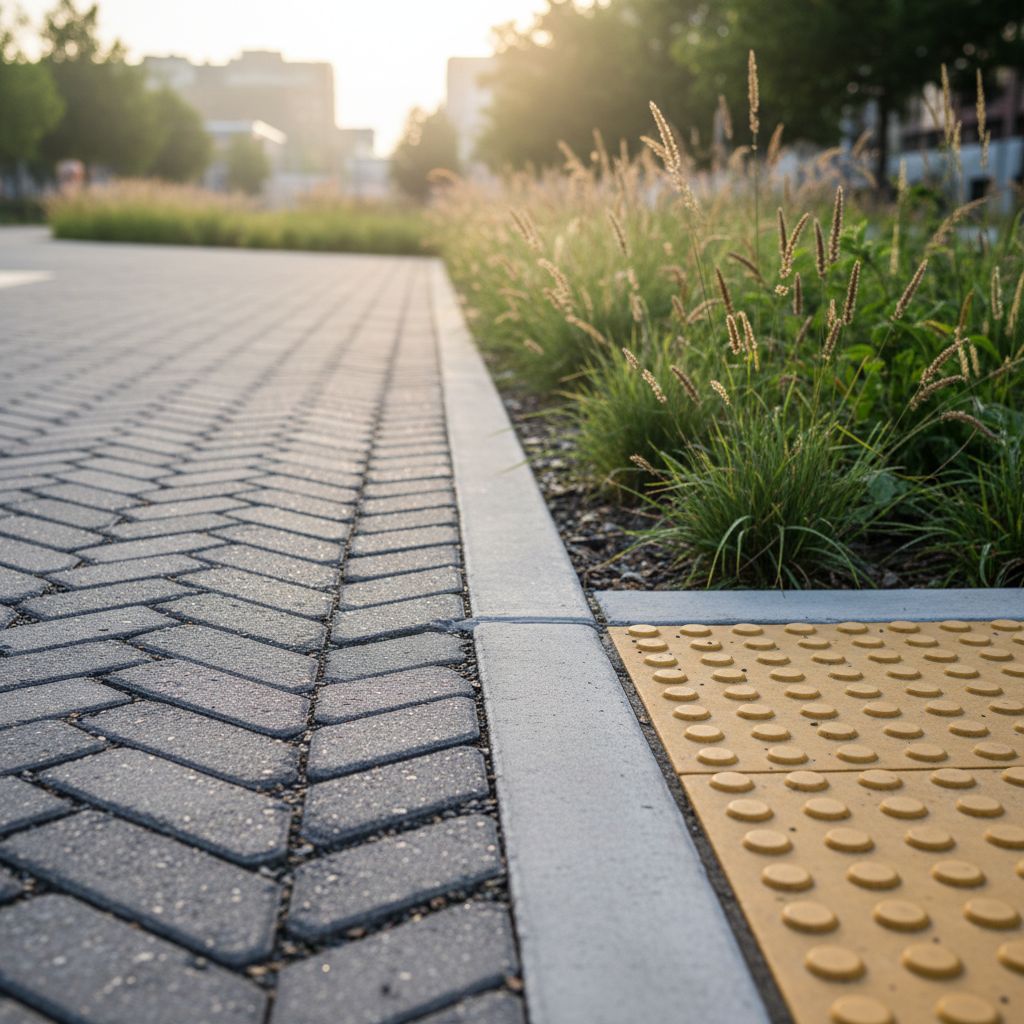
- Permeable pavers at walkways and overflow parking to reduce ponding and heat.
- Tree trenches sharing soil volumes under sidewalks to support canopy growth.
For base preparation and edge restraint concepts that keep interlocking surfaces stable, here’s an accessible overview of interlocking base prep. While not a substitute for engineering, it’s a helpful visual primer.
Best Practices (What We Specify on Texas Sites)
Decide key dimensions early, protect pedestrian desire lines, and stage construction with inspections in mind. Use green infrastructure that doubles as amenities, and document operations—like deliveries and trash—so conflicts don’t return after opening day.
Dimensions and details that prevent rework
- Drive aisles: 24–26 ft for two-way, 14–16 ft for one-way (angled parking).
- Accessible routes: Maximum 5% running slope and 2% cross slope; landings at grade changes.
- Parking: 9×18 ft standard stalls; 12–13 ft for accessible with an adjacent access aisle.
- Lighting: Full-cutoff fixtures; target 1–3 foot-candles in active areas with good uniformity.
- Shade and seating: Trees at 25–40 ft spacing plus benches near entries improve dwell times.
Operations planning you can draw
- Delivery paths mapped with turning templates and reinforced pavement at tight corners.
- Trash collection concealed from primary frontage, with pads sized for truck maneuvering.
- Queue sizing at pumps or drive-thrus set for 2–3 vehicles per bay to avoid spillback.
Our site preparation and excavation crews coordinate with design to preserve ADA slopes after paving lifts, not just on paper. That coordination eliminates many late-stage corrections.
Tools and Resources (Draw, Test, Verify)
Use layered due diligence, context-based street standards, vehicle-swept path analysis, and stormwater modeling. Combine CAD/BIM with GIS, and document assumptions so reviewers can trace each decision from code to detail.
Design and analysis stack
- GIS + aerials to map zoning, utilities, floodplains, and access spacing before concept layouts.
- CAD/BIM for site plans, cross-sections, and grading tie-ins that match field staking.
- Turning templates for SU-30 through WB-67 vehicles at driveways and loading zones.
- Hydrology models for detention, outlet control, and water-quality volume sizing.
Permitting exhibits that speed approvals
- One-sheet site plan with dimensions, curb radii, and lane widths called out clearly.
- Landscape and lighting plans coordinated with utilities to avoid relocations.
- Access management plan showing turn restrictions, medians, and sight triangles.
We package these with our urban planning services so each submittal reads cleanly and aligns with the local review sequence.
For a practical safety overview relevant to construction logistics and site setup, this summary on improving construction site safety offers a straightforward checklist perspective.
Case Studies and Examples (Texas Scenarios)
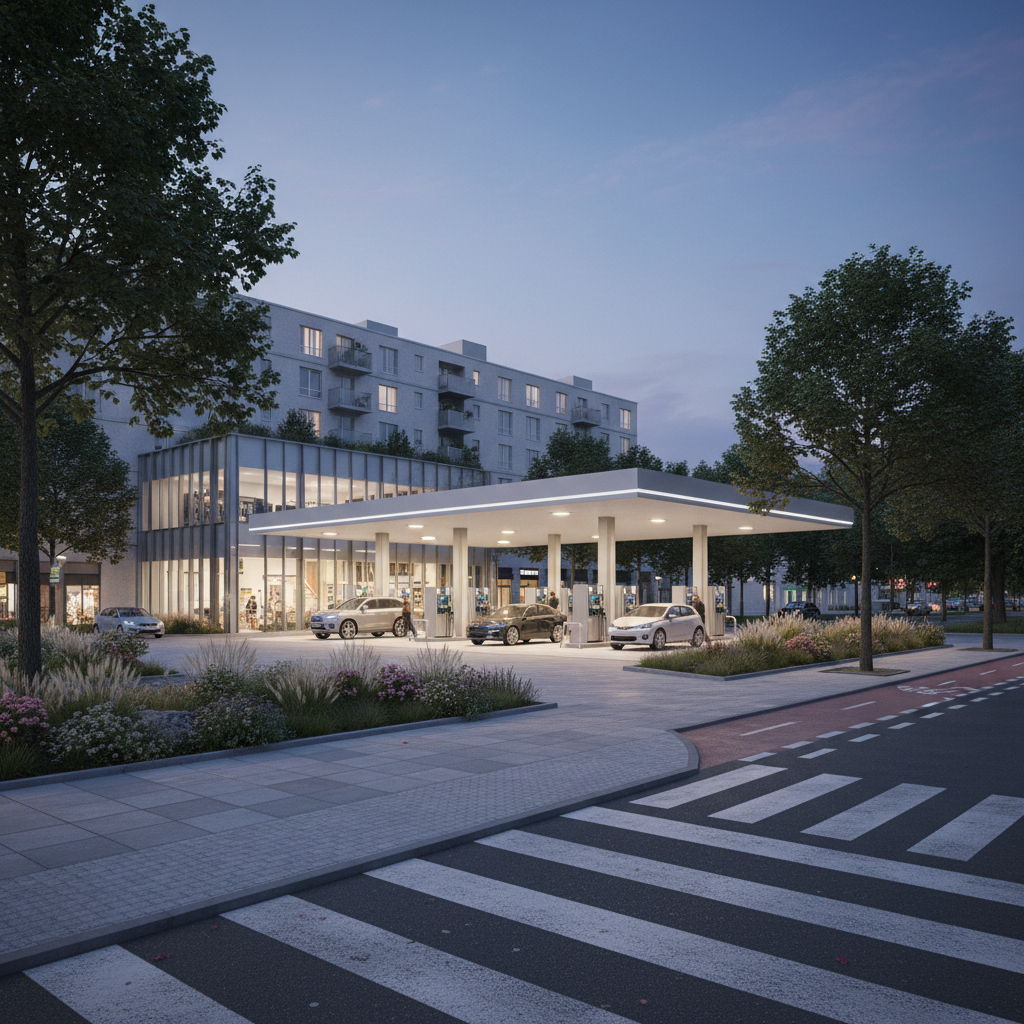
From fuel retail to mixed-use corners, small layout choices change outcomes. These Texas-inspired scenarios show how access spacing, queueing, and pedestrian routes improve safety, shorten reviews, and keep operations smooth after opening.
Fuel retail (gas station and C-store)
- Issue: Two closely spaced driveways created risky left turns and queue spillback at peak hours.
- Design move: Consolidated access to a single full-movement driveway plus a right-in/right-out; added a median and a marked crosswalk to the storefront.
- Result: Fewer conflict points, clearer operations, and better foot access to entries and restrooms.
Commercial corner (retail + restaurant)
- Issue: Delivery trucks cut through parking, blocking ADA routes and on-site circulation.
- Design move: Mapped a dedicated delivery path with reinforced paving; shifted accessible stalls to the calmest bay; tightened curb returns to slow turning traffic.
- Result: ADA path stayed clear; queues no longer spilled across the main aisle; dwell time rose with shade and seating at entries.
Neighborhood infill (residential)
- Issue: A long block funneled all traffic to one stop sign, increasing delays and discouraging walking.
- Design move: Introduced a mid-block paseo and a new T-intersection; added street trees and on-street parking to calm speeds.
- Result: Slower speeds, more route choice, and better curb appeal for new homes built to modern elevations.
Process & Delivery Models (Who Does What)
Choose a delivery model that keeps design intent intact. Design–Bid–Build separates roles; Design–Build unifies them for speed; Construction Manager at Risk blends early constructability with competitive pricing.
| Model | Pros | Cons | Best when… |
|---|---|---|---|
| Design–Bid–Build | Clear roles; competitive bids | Later coordination; change exposure | Scope is stable; low complexity |
| Design–Build | Single point of accountability; faster | Owner needs clear performance specs | Speed is critical; tight schedules |
| CM at Risk | Early constructability; cost control | More management effort | Complex or phased projects |
Tip Top Builders leads projects across all three models. Our commercial construction and residential construction teams keep urban design decisions—like lane widths and ADA slopes—front and center during field coordination.
Local considerations for Galveston
- Plan for coastal weather: specify corrosion-resistant fixtures and prioritize drainage paths that stay clear during heavy rain and tidal conditions.
- Schedule key inspections outside the peak storm season when possible to reduce rescheduling risk and material exposure.
- Design pedestrian routes with shade and wind protection to make walking comfortable in humid, breezy conditions common along the Texas Gulf Coast.
Need a constructability check? If you have a concept plan or pre-submittal package, our team can review driveway spacing, queueing, ADA slopes, and stormwater early. Start with our urban planning services or planning and development overview.
Frequently Asked Questions
Here are direct answers to common questions Texas developers ask about urban design, permitting, and site delivery, distilled from our daily work on fuel retail, commercial, and neighborhood projects.
What’s the difference between urban design and site planning?
Urban design sets the context—street sections, block structure, and frontage types—so a site plan can fit the network. Site planning adapts those rules to a parcel with grading, drainage, parking, and lighting that meet code and operations.
How early should we involve an urban designer?
Bring urban design into due diligence. Early layouts catch driveway spacing, queue lengths, and stormwater needs before engineering begins. That keeps later revisions small and helps permitting move faster.
Does urban design add time to permitting?
It typically shortens reviews because geometry, access, and pedestrian routes are clear up front. Reviewers spend less time asking for rework when lane widths, curb radii, and ADA paths are dimensioned and justified.
What are quick wins for fuel retail sites?
Consolidate driveways, tighten curb returns to slow turns, stripe crosswalks to the storefront, and shade main entries. Size queues for 2–3 vehicles per pump, and keep ADA paths away from the highest-traffic bay.
Key Takeaways
Urban design turns policy into precise, buildable geometry. Decide standards early, integrate drainage with landscape, and document operations so your project opens strong and stays efficient.
- Set lane widths, sidewalks, and curb radii before engineering to reduce rework.
- Protect pedestrian desire lines; keep ADA routes simple, short, and shaded.
- Integrate bioswales and permeable surfaces to control runoff and heat.
- Map deliveries, trash, and emergency access so conflicts don’t return later.
- Choose a delivery model that preserves design intent during construction.
Conclusion and Next Steps
Urban design is how places work. When you align streets, frontage, drainage, and operations before engineering, you shorten reviews and open sites that feel safe and perform well—across Texas contexts from Galveston to the Hill Country.
- Start with due diligence and a 1–2 page concept that fixes key dimensions.
- Pair urban design with site preparation and construction management planning.
- If you’re planning fuel retail, align queueing, canopy clearances, and ADA paths early.
- Ready to move? Our Galveston-based team supports projects statewide—from access spacing to final striping.