
Construction quality control is the systematic process of preventing defects and verifying that work meets project requirements, codes, and specifications. For Galveston projects managed by Tip Top Builders, it aligns planning, inspections, testing, and documentation from site prep to punch list so every gas station, commercial, and residential build delivers safe, compliant results.
By Aftab Ali • Last updated: May 23, 2026
Overview: Construction Quality Control in Texas
Construction quality control (QC) in Texas verifies that materials and workmanship match the plans, specs, and codes at every phase. A strong QC program defines standards, inspects work continuously, documents results, and corrects issues fast—keeping safety, schedule, and compliance on track from groundbreaking to handover.
Here’s what you’ll get in this complete, service-focused guide from Tip Top Builders in Galveston:
- Clear definition of QC and how it supports safety, schedule, and compliance
- Texas-focused processes from plan review and ITPs to punch lists and closeout
- Methods, tools, and templates used on gas station, commercial, and residential jobs
- Practical best practices, checklists, and case-style examples from around the state
At a glance (Table of contents)
- What is construction quality control?
- Why construction quality control matters
- How construction quality control works
- Types, methods, and approaches
- Best practices for consistent results
- Tools, templates, and resources
- Case studies and examples in Texas
- Frequently asked questions
- Conclusion and next steps
Local considerations for Galveston
- Plan QC around coastal humidity and wind exposure. Fasten exterior assemblies and verify corrosion-resistant materials during submittal review and field checks.
- Account for storm seasons. Sequence inspections for site drainage, fuel tank protection, and envelope water intrusion testing before heavy rain windows.
- Coordinate early with local authorities for permits, inspections, and environmental requirements tied to fuel systems and right-of-way work.
What Is Construction Quality Control?
Construction quality control is the planned, documented system for ensuring materials and workmanship meet contract requirements. It combines standards, submittal reviews, inspections, testing, and corrective actions so each activity is verified once and built right the first time.
When we say “quality,” we mean conformity to requirements—not just “looking good.” On Texas jobs, that means your drawings and specifications, applicable codes, manufacturer guidance, and the inspection/test plans (ITPs) that spell out who checks what, when, and how.
- Standards baseline: Project specs, codes, and manufacturer instructions define acceptance criteria.
- Submittals and mockups: We confirm products and methods match requirements before installation.
- Inspections and testing: Daily checks, special inspections, and lab tests verify actual performance.
- Nonconformance management: Issues get logged, corrected, and re-verified with traceable records.
- Closeout quality: Punch lists, as-builts, O&M manuals, and training ensure a strong turnover.
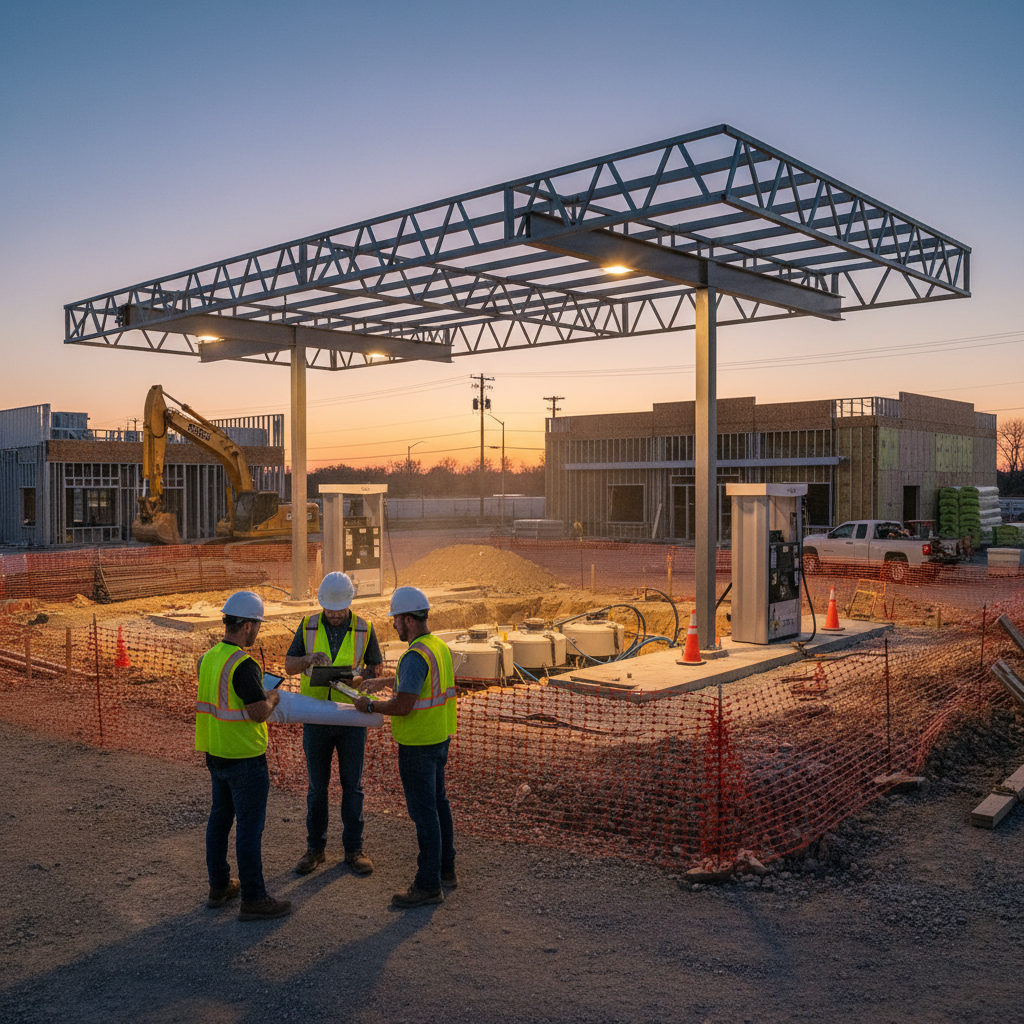
For fuel retail developments, QC also includes tank installation tolerances, canopy steel alignment, dispenser anchorage, and documented leak detection tests—elements we manage within a single, coordinated plan.
Why Construction Quality Control Matters
Quality control protects people, budgets, and brand reputation. It reduces rework, ensures compliance, and documents conformance—helping owners open on time with fewer surprises. Strong QC also supports warranties and lowers lifecycle risks by catching problems when they’re cheapest to fix.
Owners feel the impact where it counts: fewer callbacks, cleaner inspections, and predictable opening dates. For gas stations and C-stores, it’s also about regulatory confidence across underground storage, vapor recovery, and fire/life safety.
- Safety and compliance: Verified installations reduce hazards and inspection delays.
- Schedule reliability: Planned verifications keep crews moving and avoid late-stage rework.
- Cost containment: Early detection prevents cascading fixes across trades.
- Asset performance: Tested systems last longer and operate as designed.
- Documentation trail: QC records support warranties and future maintenance.
On Tip Top Builders projects, we tie QC to our planning and design process and to field execution through site preparation and excavation and construction management. That connection is where predictability is born.
How Construction Quality Control Works
Quality control works by turning specifications into checkable steps. We plan verifications, inspect installed work, test materials and systems, and document outcomes. When something deviates, we correct it fast, re-test, and close the loop—so each phase finishes right the first time.
On Texas projects, we standardize QC into repeatable, auditable workflows owners and inspectors can follow at a glance. Here’s the core loop we run on gas station, commercial, and residential builds:
- Define acceptance criteria: Extract spec sections and code references into checklists.
- Approve submittals: Confirm materials and methods meet the criteria before delivery.
- Field inspections: Verify installation steps (pre-pour, in-progress, final) with photos and notes.
- Materials testing: Perform lab tests (e.g., concrete cylinders at 7/28 days; soils density tests).
- System testing: Pressure tests, continuity checks, and functional startups for MEP and fuel systems.
- Corrective action: Log nonconformances, fix causes, and re-inspect.
- Closeout quality: Punch lists, training, and complete as-builts hand over a ready-to-run facility.

QC vs. QA vs. Commissioning
| Discipline | Primary Goal | Focus | Timing | Example Activity |
|---|---|---|---|---|
| Quality Control (QC) | Verify work meets requirements | Inspections & tests | Daily, phase-by-phase | Concrete slump and cylinder testing |
| Quality Assurance (QA) | Ensure the process is effective | Plans, procedures, audits | Before & during execution | Review ITPs and submittal procedures |
| Commissioning (Cx) | Demonstrate systems perform as intended | Functional performance | Late construction through turnover | Fuel system startup & leak verification |
We integrate all three. QA gives the playbook, QC runs the plays, and commissioning proves the building performs—so owners open with confidence.
Types, Methods, and Approaches
Effective QC blends prevention and verification: submittal reviews and mockups to prevent errors, then inspections and testing to prove conformance. On Texas sites, we use ITPs, special inspections, materials labs, and trade checklists aligned to each phase.
Core methods
- Inspection and Test Plans (ITPs): Define hold points and acceptance criteria by activity.
- First-article inspections: Validate the first instance (e.g., first fuel line run) before production scale.
- Special inspections: Structural, geotechnical, and other third-party verifications where required.
- Materials testing: Soils density, concrete compressive strength, asphalt compaction, coatings DFT, etc.
- System functional tests: Pressure/flow tests for plumbing and fuel, continuity/megger tests for electrical.
Documentation and traceability
- Daily inspection logs: Photos with locations, acceptance notes, and signatures.
- Nonconformance reports (NCRs): Describe the issue, disposition it (repair/replace), and track closure.
- Material certs and mill sheets: Keep certificates for anchors, reinforcing, coatings, and tanks.
- As-built redlines: Update drawings as changes occur for reliable turnover packages.
Material and field testing are the backbone of objective verification. For a quick refresher on common testing services, see this concise outline of quality control testing types; the categories mirror many tests we use in Texas, even though standards vary by jurisdiction.
Trade-specific quality in practice
- Civil & foundations: Subgrade proof-rolling, moisture-density control, rebar placement checks, concrete finish tolerances.
- Structural steel: Bolt tension verification, weld inspection, frame plumbness, canopy alignment for gas sites.
- Architectural: Air/water barriers continuity, flashing terminations, storefront anchorage, finish quality.
- MEP & fuel systems: Pressure, leak, and function tests; labeling and isolation verification.
- Electrical: Conduit routing, grounding and bonding, load balancing, panel schedules and labeling; an overview of sequencing appears in this electrical construction guide.
We tailor these methods for project type. A C-store canopy demands tight steel tolerances and coordinated lighting tests, while a residence emphasizes envelope sealing and interior finish QA with homeowner walk-throughs.
Best Practices for Consistent Results
The best QC programs make quality routine: define standards early, verify continuously, and document everything. Empower foremen to self-check, use clear checklists, and resolve issues the same day. Owners win with fewer delays and a cleaner handover.
Make quality visible
- Start with design clarity: Eliminate ambiguity in drawings and specs before procurement. Our planning and design team leads this step.
- Post the plan: Keep ITPs, hold points, and acceptance criteria on the wall of the job trailer.
- Color-code checklists: Pre-pour, in-progress, and final checks in separate colors for quick scanning.
Prevent rework
- First-install reviews: Inspect the first instance of repetitive work (duct runs, dispenser islands) before scaling up.
- Coordinate early: Clash-detect pumps, piping, and canopy steel with lighting layouts before fabrication.
- Field-approve substitutions: Verify performance equivalence against specs with documented owner approval.
Close the loop daily
- Daily huddles: Confirm the day’s inspections, tests, and access needs with every trade lead.
- Same-day NCR resolution: Don’t let defects age. Fix, recheck, and sign off before crews leave.
- Photo-first documentation: Pair every acceptance with time-stamped photos and location tags.
These habits compound. When crews expect verification and see fast decisions, momentum builds and schedule risk shrinks.
Tools, Templates, and Resources
High-performing QC teams use simple, repeatable tools: phase checklists, ITP templates, daily logs, and photo documentation. Add calibrated test equipment and clear submittal stamps, and you’ve built a lightweight system that scales from pads and tanks to interiors and finishes.
Field-ready templates we use
- ITP template: Activity, reference standard, acceptance criteria, inspection type, hold point, responsible party, record location.
- Pre-pour checklist: Rebar cover, formwork, embed locations, sleeves, clearances, slump/air tests, curing plan.
- MEP/fuel functional test sheet: Test pressures, durations, pass/fail criteria, signatures, re-test plan.
- Punch list sheet: Location grid, issue, responsible trade, target date, photo proof, sign-off.
Essential test equipment
- Concrete slump cone, air meter, cylinder molds, thermometers, and maturity sensors
- Nuclear density gauge for soils/asphalt (or approved alternatives)
- Pressure test kits, manometers, leak-detection equipment for piping and fuel systems
- Multimeters, insulation resistance testers (megger), and load banks for electrical
If you’re organizing your first QC kit, mirror what your most frequent tasks demand. For gas stations, prioritize soils/asphalt compaction, concrete testing, and fuel system pressure/leak equipment; for residences, emphasize envelope tests and interior finish checks.
Free QC kickoff call: Need a project-specific inspection and test plan? Tip Top Builders can map your ITPs and checklists to your drawings so field teams move faster from day one.
Schedule a consultation to align QC with your schedule, permitting, and inspections.
Case Studies and Examples in Texas
Our QC playbook adapts to project type. On gas stations, we focus on tanks, canopies, paving, and fuel systems. On commercial shells, we prioritize structure, envelope, and MEP startup. For residences, we emphasize envelope sealing, interiors, and owner walk-throughs.
Fuel retail (gas station + C-store)
- Underground tanks: Excavation shoring and bedding verified; elevation tolerances and anchorage confirmed; documented leak and pressure tests before backfill.
- Canopy steel: Bolt tension and plumbness verified; lighting and signage mounts inspected before wiring pull.
- Paving & striping: Compaction tests by grid; slopes checked to prevent ponding at dispenser islands.
Coastal conditions around Galveston push us to specify coatings and fasteners with superior corrosion resistance and to double-check envelope water management before commissioning.
Commercial shell + build-out
- Structure: Special inspections on anchors and welds; deflection checks for glazing compatibility.
- Envelope: Air/water barrier continuity; window/door flashing; roof terminations and drains water-tested.
- MEP startup: Functional tests with sequence-of-operations verification and balancing.
Where owners plan phased tenant improvements, we document baseline performance values so each future build-out can be tested against a known-good state.
Residential construction
- Site and slab: Moisture barrier and rebar chairs checked; concrete finish flatness measured against spec.
- Envelope and HVAC: Continuous air barrier verified; duct and pressure tests; attic and wall insulation inspections.
- Owner walk-through: Room-by-room punch lists, device labeling, and warranty orientation.
Explore how our teams execute residential QC within broader project oversight through our residential construction service.
Phase-by-phase QC checklist (starter)
- Preconstruction: Define acceptance criteria; draft ITPs; confirm permit inspection points.
- Sitework: Erosion control in place; proof-roll; compaction tests; utility trench bedding checks.
- Foundations: Rebar, embeds, sleeves; concrete sampling; curing plan.
- Structure: Framing tolerances; connectors; weld inspections; canopy plumbness.
- Envelope: Flashing; sealants; water intrusion tests; roof terminations.
- Interiors: Wall/ceiling close-in inspections; finish tolerances; fixture alignment.
- MEP/Fuel: Pressure/continuity tests; sequence verification; labeling and access.
- Closeout: Punch list burn-down; as-builts; O&M manuals; training; warranty kickoff.
For complex scopes, we pair this with at-risk or CM frameworks. See how we manage delivery models in our comparisons of CMAR vs. Design-Build and EPCM vs. CM.
Bringing Planning, Site Prep, and QC Together
Quality is strongest when design clarity, site preparation, and daily verification work as one system. Align submittals and ITPs with drawings, prep the site to spec, and verify every step in the field—your schedule and inspections will fall into line.
Because Tip Top Builders covers the full stack—planning & design, site preparation & excavation, and construction management—we’re able to thread QC from precon to turnover without handoff friction.
- Design clarity: Resolve conflicts before the first purchase order.
- Site precision: Grade, compact, and proof-roll to the letter; stormwater controls in place.
- Execution discipline: Daily inspections, tests, and issue closure with photo proof.
That’s how we keep Texas projects moving—whether in Galveston or across our broader service area.
Frequently Asked Questions
Common QC questions focus on timing, scope, and responsibilities. Here are direct answers owners and developers ask us most often on Texas projects—from preconstruction planning to final punch and closeout.
What should be in a construction quality control plan?
Include acceptance criteria from specs and codes, roles and responsibilities, inspection and test plans, submittal logs, nonconformance procedures, and documentation requirements. Align the plan to permit inspections and commissioning milestones so field teams know exactly what to check and when.
How often should inspections and tests occur?
Inspections occur daily by the responsible trade and superintendent, with defined hold points at key stages (pre-pour, pre-drywall, pre-cover). Testing follows the specs—common examples include soils density per lift, and concrete cylinders tested at 7 and 28 days.
Who is responsible for closing nonconformances?
The installing trade corrects the issue, while the superintendent or QC manager verifies the fix. Document with photos and signatures, then update logs. Don’t move forward until the nonconformance is officially closed and re-verified.
How does QC differ between gas stations and residential builds?
Fuel retail projects add specialized verifications—tank bedding, piping pressure/leak tests, canopy steel alignment, and dispenser anchorage—on top of typical civil, structural, and MEP checks. Residential QC emphasizes envelope sealing, interior finishes, and homeowner walk-throughs.
Can Tip Top Builders help write ITPs and checklists?
Yes. We create project-specific ITPs, phase checklists, and punch lists aligned to your drawings, permit inspections, and commissioning requirements—so field teams know exactly what to verify at each step.
Conclusion and Next Steps
Quality control succeeds when expectations are clear, verification is routine, and documentation is airtight. If your teams can see the standard, check the work, and prove it on paper, you’ll open on time with confidence.
- Key takeaways: Define acceptance criteria early; inspect and test continuously; close issues fast; document everything.
- Owner action: Ask for an integrated QC plan that covers design through commissioning.
- Next step: Start with a QC kickoff—templates, ITPs, and a schedule-aligned inspection matrix.
Ready to align your Texas project with proven QC? Let’s build your plan—from Galveston to Austin and beyond. Book a discovery session with Tip Top Builders.